

A good trading month can feel amazing, but the bigger question is what happens after the profit lands in your account. That is why beginners often search for what is the 70/20/10 rule in trading. It gives your trading profits a simple plan instead of letting excitement, fear, or random spending make the decision.
What The Rule Means
The 70/20/10 rule becomes easier to use once you understand its basic purpose.
A Simple Profit Split
In trading, the 70/20/10 rule is a profit distribution method. It suggests leaving 70% of your net trading profits in your trading account, moving 20% into separate long-term investments, and withdrawing 10% for personal spending.
For example, if you make $1,000 in net trading profit, $700 stays in the trading account, $200 goes into long-term wealth builders, and $100 can be used as personal cash. This keeps your money organized and gives every dollar a role.
The word “net” matters here. You should apply the rule after losses, fees, commissions, platform costs, and estimated taxes. That makes the system more realistic and safer for beginners.
Not A Position Size Rule
A common mistake is thinking the 70% means you should risk 70% of your account. That is not what this rule means. Risking such a large amount on trades can damage your capital quickly.
Position sizing is a separate part of risk management. It deals with how much you risk on each trade, where you place stop losses, and how much exposure your account can handle.
The 70/20/10 rule answers a different question: what should you do with trading profits after you have earned them?
How The 70/20/10 Rule Works
The rule works best when each part has a clear purpose and is applied consistently.

70% Reinvested For Compounding
The first 70% stays in your trading account. This portion can help your account grow over time, especially if you have a tested strategy and strong risk controls.
Compounding means your profits may help generate future profits. A larger account can give you more flexibility, better trade selection, and smoother risk management. But larger capital should never become an excuse for reckless trading.
This part is useful only when your trading is disciplined. If your strategy is inconsistent, leaving more money in the account may simply expose more capital to poor decisions.
20% For Long-Term Investing
The next 20% moves out of active trading and into longer-term assets. This may include index funds, ETFs, blue-chip stocks, retirement accounts, bonds, or high-yield savings, depending on your goals and risk tolerance.
This bucket protects part of your trading success from future drawdowns. Trading income can change quickly, but long-term investing is usually built on patience, diversification, and steady participation in the market.
Think of this 20% as a bridge between trading profits and wealth creation. It helps you avoid keeping every dollar tied to short-term price swings.
10% For Personal Spending
The final 10% is money you can withdraw and use personally. You might spend it on a dinner, a vacation, family needs, learning tools, or anything that feels meaningful.
This part may sound small, but it matters psychologically. Trading requires focus, patience, and emotional control. Enjoying a limited portion of profits can reduce burnout and make the process feel more rewarding.
The key is keeping the reward controlled. You enjoy the win without weakening your account or ignoring your long-term plan.
How To Use What Is The 70/20/10 Rule In Trading
Applying what is the 70/20/10 rule in trading should feel simple, practical, and repeatable.
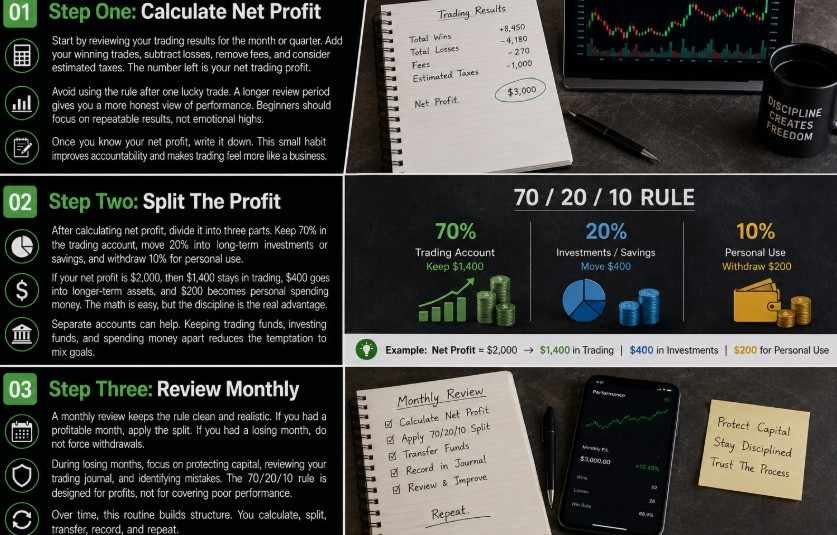
Step One: Calculate Net Profit
Start by reviewing your trading results for the month or quarter. Add your winning trades, subtract losses, remove fees, and consider estimated taxes. The number left is your net trading profit.
Avoid using the rule after one lucky trade. A longer review period gives you a more honest view of performance. Beginners should focus on repeatable results, not emotional highs.
Once you know your net profit, write it down. This small habit improves accountability and makes trading feel more like a business.
Step Two: Split The Profit
After calculating net profit, divide it into three parts. Keep 70% in the trading account, move 20% into long-term investments or savings, and withdraw 10% for personal use.
If your net profit is $2,000, then $1,400 stays in trading, $400 goes into longer-term assets, and $200 becomes personal spending money. The math is easy, but the discipline is the real advantage.
Separate accounts can help. Keeping trading funds, investing funds, and spending money apart reduces the temptation to mix goals.
Step Three: Review Monthly
A monthly review keeps the rule clean and realistic. If you had a profitable month, apply the split. If you had a losing month, do not force withdrawals.
During losing months, focus on protecting capital, reviewing your trading journal, and identifying mistakes. The 70/20/10 rule is designed for profits, not for covering poor performance.
Over time, this routine builds structure. You calculate, split, transfer, record, and repeat.
Alternative Investing Meanings
The 70/20/10 rule can mean different things depending on the investing context.

Portfolio Asset Allocation
Some investors use a 70/20/10 structure for portfolio allocation. In that version, 70% may go into core stable assets, 20% into measured growth assets, and 10% into higher-risk opportunities.
This is not the same as the trading profit rule, but the idea is similar. Both systems try to balance growth, protection, and controlled risk. For beginners, the lesson is simple: percentages are useful only when the purpose is clear.
Market Driver Theory
Another interpretation comes from Wall Street thinking. It suggests that, in the short term, a stock’s return may be influenced mostly by the broader market, then by the industry group, and finally by the company itself.
In this view, 70% is linked to market trends, 20% to industry performance, and 10% to company fundamentals. This is more about understanding price movement than dividing profits. It reminds traders that even strong companies can move with the overall market. That is why market context matters.
Smart Tips For Beginners
The rule is helpful, but it should be used with common sense to stop overspending money.
Plan For Taxes First
Trading profits may create tax obligations depending on your location, account type, holding period, and trade frequency. Before applying the split, consider setting aside money for taxes.
This keeps your profit plan realistic. Spending or reinvesting money that may belong to taxes can create stress later. For personal tax advice, speak with a qualified tax professional.
Use Risk Controls
The 70/20/10 rule does not replace stop losses, position sizing, trade journals, or risk limits. It works alongside them. Beginners should avoid risking too much on one trade. Protecting capital is more important than chasing fast returns. A good profit rule is useful only when paired with a smart trading process.
Frequently Asked Questions
1. Which Is Better, 70/20/10 Or 50/30/20?
The 50/30/20 rule is better for managing personal income and household budgets. The 70/20/10 rule in trading is better for splitting net trading profits after profitable periods.
2. How Do I Turn $10,000 Into $100,000?
Turning $10,000 into $100,000 requires time, skill, patience, and controlled risk. Trying to grow money too quickly can lead to large losses and emotional trading mistakes.
3. How Much Money Do I Need To Invest To Make $3,000 A Month?
It depends on your expected return. Using a 4% annual withdrawal rate, earning $3,000 monthly may require around $900,000 invested, though higher returns usually involve higher risk.
4. What Is Warren Buffett’s 90/10 Rule?
Warren Buffett’s 90/10 rule usually means placing 90% in a low-cost S&P 500 index fund and 10% in short-term government bonds for long-term simplicity.
Profit Party, But Make It Planned
Understanding what is the 70/20/10 rule in trading can help beginners turn profits into a clear routine. Keep 70% for trading growth, move 20% toward long-term investing, and enjoy 10% responsibly. The rule will not make every trade successful, but it can help you manage wins with discipline, balance, and a stronger investing mindset.